Austin’s Manufacturing Renaissance: What Amazon’s New Robotics Facility Signals for Industrial Real Estate | David Goodnight Austin

Austin’s Manufacturing Renaissance: What Amazon’s New Facility Says About Industrial Demand
Austin has long been associated with technology, startups, semiconductors, and software. But in 2026, another side of the city’s economy is becoming increasingly difficult to overlook: advanced manufacturing.
Amazon’s announcement of a new multi-billion-dollar robotics manufacturing facility in Austin is one of the clearest recent examples of that shift. The company announced on August 19, 2026, that its new Austin facility will manufacture robotics systems used in Amazon operations and create approximately 300 to 500 manufacturing and engineering jobs. Amazon said the project builds on more than $100 billion invested in Texas since 2010.
For Austin commercial real estate, the significance extends well beyond one company or one factory.
The project offers another indication that Austin’s industrial economy is evolving from a market dominated by conventional warehouse and distribution demand into one increasingly influenced by robotics, semiconductors, advanced manufacturing, engineering, logistics, and technology-intensive production.
For observers such as David Goodnight Austin, the development provides an interesting lens through which to understand where Austin industrial real estate may be heading next.
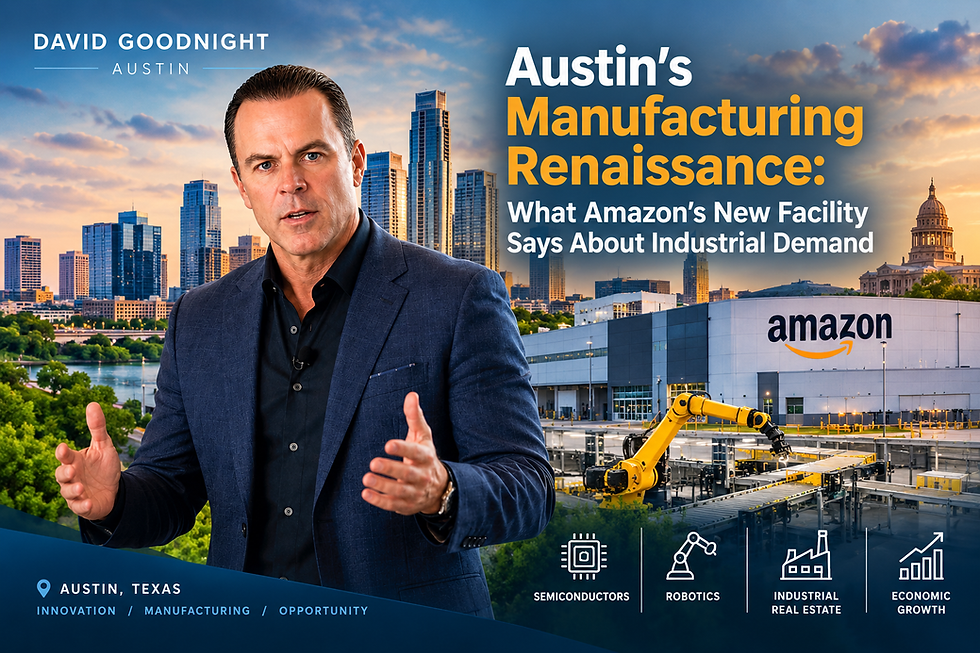
Why Amazon’s Austin Facility Matters
Amazon’s new facility is not simply another distribution center.
The company says the Austin operation will produce robotics systems designed to work alongside Amazon employees, handling repetitive tasks and heavy lifting. The facility will therefore connect manufacturing with Amazon’s broader automation and logistics infrastructure.
That distinction matters for commercial real estate.
Traditional distribution facilities primarily require large floor plates, loading infrastructure, truck access, storage capacity, and proximity to transportation networks. Advanced manufacturing can require many of those same characteristics while adding requirements for specialized electrical capacity, engineering space, sophisticated building systems, production areas, testing environments, and access to highly skilled workers.
As more technology companies move into physical production, the definition of desirable industrial property is changing.
Austin Is Building a More Diverse Manufacturing Base
Amazon’s investment arrives as Austin and Central Texas continue to attract activity connected to semiconductors and advanced manufacturing.
Recent industrial-market research shows that semiconductor-related investment is already influencing demand across the broader Austin region. ECR reported that Austin-area companies received approximately 78% of Texas’s $458.9 million Semiconductor Innovation Fund awards in 2026, with Samsung’s Taylor semiconductor plant accounting for a major portion of the awards. Suppliers and supporting manufacturers have also been expanding in communities such as Taylor, Georgetown, Round Rock, and Cedar Park.
That creates an important real estate effect.
A major manufacturing project rarely operates in isolation. It can generate demand for component suppliers, equipment maintenance companies, logistics providers, engineering firms, packaging operations, specialized contractors, and other industrial users.
In other words, one large facility can become an industrial ecosystem catalyst.
Amazon’s Austin robotics facility fits naturally into that broader pattern.
Industrial Real Estate Demand Is Recovering—But Unevenly
The Amazon announcement should not be interpreted as proof that every segment of Austin industrial real estate is booming.
The market remains highly dependent on location, property type, tenant requirements, and the pace at which new supply is absorbed.
CBRE reported that Austin industrial net absorption reached 1.4 million square feet in Q2 2026, while the vacancy rate declined to 19.4%. At the same time, average asking rents were $13.78 per square foot and approximately 5.9 million square feet remained under construction.
Colliers reported a similar improvement in market momentum, recording 1.3 million square feet of net absorption during Q2 and a vacancy rate of 21.4%. Its research also showed that Austin's industrial inventory had reached approximately 105.8 million square feet.
Different brokerage firms use different inventories and methodologies, so the exact vacancy figure varies. The broader message, however, is consistent: leasing demand improved during the second quarter while construction activity began moderating.
That makes Amazon’s investment particularly relevant.
The New Industrial Tenant Is More Technology-Intensive
One of the most important changes in Austin industrial real estate is the evolution of the industrial tenant itself.
Manufacturers today can require significantly more technology infrastructure than traditional industrial occupiers.
Robotics manufacturers, semiconductor suppliers, aerospace companies, defense technology firms, and advanced electronics businesses may require:
High-capacity electrical infrastructure
Specialized manufacturing environments
Research and development areas
Advanced automation systems
Testing and quality-control space
High-speed connectivity
Employee amenities and technical training areas
Strategic transportation access
Room for future production expansion
This changes the competitive landscape for industrial properties.
A basic warehouse may compete primarily on rent, size, location, and loading capacity. A technology-intensive manufacturing facility may evaluate a much broader set of factors.
For Austin property owners and developers, that could make building functionality and infrastructure increasingly important.
Location Is Becoming More Strategic
Amazon’s Austin project is also significant because of where the development is taking shape.
The facility is associated with the large Dog’s Head development area in East Austin. In July 2026, Austin City Council authorized negotiations with Travis County related to Tax Increment Reinvestment Zone No. 21 covering approximately 2,645 acres in the area generally known as Dog’s Head.
Local reporting identified Amazon as the company behind the proposed robotics manufacturing operation at the site.
Amazon itself said it selected Austin because of the city’s engineering talent, university partnerships, and innovation ecosystem. The company also highlighted its existing presence of approximately 17,000 employees in Austin and 86,000 across Texas.
That combination of workforce, research institutions, transportation infrastructure, and existing corporate presence helps explain why Austin can compete for manufacturing projects that might once have been concentrated in more traditional manufacturing centers.
What This Could Mean for Austin Industrial Property
The most interesting implication may be the potential ripple effect.
When a company like Amazon establishes a robotics manufacturing operation, the real estate impact does not necessarily stop at the facility itself.
Suppliers may need nearby industrial space. Contractors may require yards and service facilities. Logistics companies may seek additional capacity. Engineering businesses may look for flex or research-and-development space. Workers may increase demand for housing and services around employment centers.
This creates a layered relationship between manufacturing and commercial real estate.
For David Goodnight Austin, that connection is particularly relevant when considering the future of Austin property markets. Industrial real estate is no longer simply about storing products. Increasingly, it is about supporting the infrastructure behind technology, production, automation, and supply chains.
Austin’s Manufacturing Story Goes Beyond Amazon
Amazon is a major signal, but it is not the entire story.
Austin’s industrial landscape is simultaneously being shaped by semiconductor investment, aerospace and space-related activity, defense technology, electric vehicles, electronics, logistics, and other technology-intensive industries.
In September 2026, for example, Axios reported that Austin-based Allen Control Systems was expanding into a 191,000-square-foot manufacturing facility as the company scaled production of its robotics-based counter-drone technology.
That development illustrates another dimension of Austin’s manufacturing evolution: companies can emerge from the region’s technology ecosystem and then require substantial physical production infrastructure.
The result is a more complicated industrial real estate market—one where technology and manufacturing increasingly overlap.
What Industrial Investors and Developers Should Watch
Amazon’s new facility does not eliminate Austin’s existing industrial challenges. Significant amounts of available space remain, and several market reports indicate that tenants still have negotiating leverage in portions of the market.
But several trends deserve attention.
First, advanced manufacturing can create specialized demand. Not every industrial building can accommodate technology-intensive production.
Second, infrastructure matters more. Power, transportation access, building specifications, and expansion potential can become decisive factors.
Third, supplier networks matter. A major manufacturing project can encourage additional industrial users to locate nearby.
Fourth, Austin’s submarkets are not identical. Recent market data shows significant differences in absorption, vacancy, and construction activity across the metro.
Finally, the development pipeline remains important. New construction can create opportunities for occupiers but can also keep vacancy elevated if deliveries outpace demand.
The manufacturing renaissance, therefore, is not simply a story about adding more square footage. It is about adding the right type of industrial space in the right locations.
The Bigger Picture for David Goodnight Austin
Amazon’s new robotics manufacturing facility represents an important chapter in Austin’s changing economic identity.
The city remains a major technology center, but its growth is increasingly reaching into physical production. Semiconductors require specialized suppliers. Robotics companies require manufacturing facilities. Advanced technology businesses need testing, assembly, logistics, and engineering space.
That creates a powerful connection between innovation and industrial real estate.
For the Austin property market, Amazon’s investment is therefore more than a corporate expansion announcement. It is another data point suggesting that the city’s next phase of industrial growth may be increasingly defined by advanced manufacturing, automation, robotics, and technology-driven supply chains.
The key question for the years ahead is not whether Austin will remain a technology hub. It is how successfully the city can continue turning technological innovation into a durable manufacturing ecosystem—and how much industrial real estate will be required to support it.
Frequently Asked Questions
What is Amazon building in Austin?
Amazon announced a new multi-billion-dollar robotics manufacturing facility in Austin in August 2026. The facility will manufacture robotics systems used in Amazon operations and is expected to create approximately 300 to 500 manufacturing and engineering jobs.
Why is Amazon building a robotics manufacturing facility in Austin?
Amazon cited Austin’s engineering talent, university partnerships, and innovation ecosystem as important factors behind the location decision. The company already has a substantial workforce and technology presence in the city.
How could Amazon's facility affect Austin industrial real estate?
The project could contribute to demand for manufacturing, supplier, logistics, engineering, and other industrial properties. Its broader impact will depend on future supplier investment, employment growth, and the pace at which existing industrial inventory is absorbed.
Is Austin's industrial real estate market growing in 2026?
Austin's industrial market showed improving absorption in Q2 2026, although vacancy remained elevated and the region still had substantial space under construction. Different research firms report different market measurements because their inventories and methodologies vary.
Is Austin becoming a manufacturing hub?
Austin is developing a broader advanced-manufacturing ecosystem involving semiconductors, robotics, aerospace, defense technology, electronics, and related supply chains. Amazon's robotics facility is one recent example of that transition.
What does Amazon's Austin investment mean for developers?
The project highlights the potential value of industrial properties that can support sophisticated manufacturing users. Developers may increasingly need to consider power availability, infrastructure, transportation, building specifications, and flexibility for technology-intensive tenants.


Comments